-
3.5" Geode Agate Hand Carved Crystal Geode Skull
Precio habitual $118.15 USDPrecio habitualPrecio unitario por -
3.4" Geode Agate Hand Carved Crystal Geode Skull | No.009
Precio habitual A partir de $101.15 USDPrecio habitualPrecio unitario por -
6.1" Geode Agate Hand Carved Crystal Geode Skull
Precio habitual $670.65 USDPrecio habitualPrecio unitario por -
2.8" Geode Agate Hand Carved Crystal Geode Skull
Precio habitual $67.96 USDPrecio habitualPrecio unitario por -
3.9" Geode Agate Human Skull Carving
Precio habitual $177.65 USDPrecio habitualPrecio unitario por
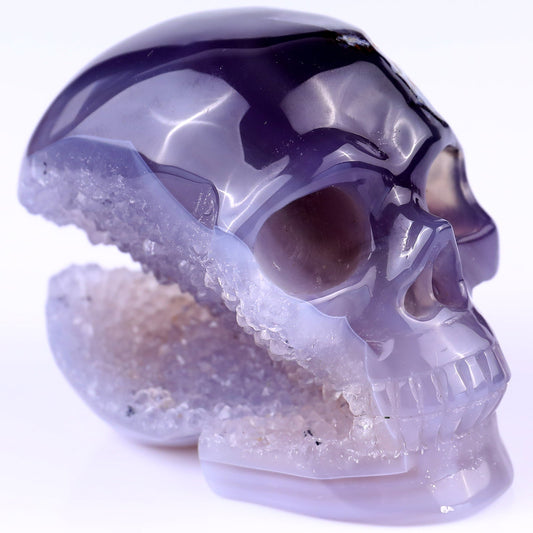
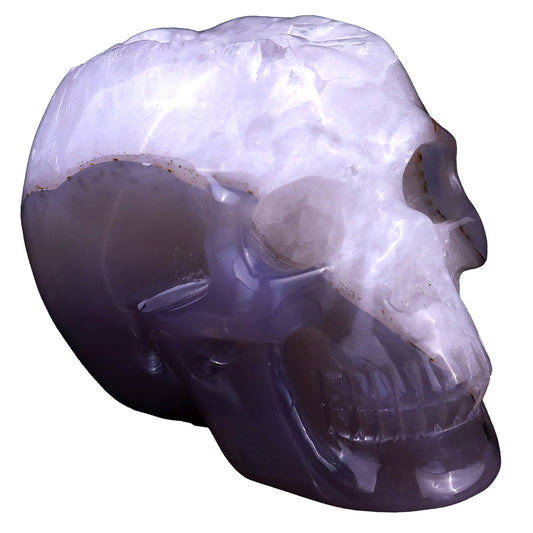


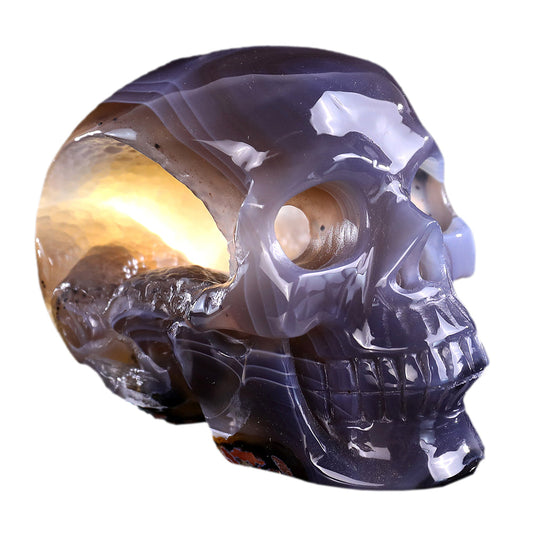
What Is a Crystal Skull?
A crystal skull is a human or creature skull carved from a single block of natural stone. This collection runs from 2 inches to 15.3 inches, with most pieces around 3 inches — small enough to hold, large enough to show the anatomy the carver was working from. If you are still deciding which one to buy, what crystal skulls are used for sets out the four reasons people actually buy them.
The famous ones deserve a straight answer. The crystal skulls held by the British Museum, the Smithsonian and the Musée du quai Branly were long presented as pre-Columbian Aztec or Maya work. Electron microscopy found rotary tool marks on all of them, and the current scholarly view is that they were cut in nineteenth-century Europe, most likely in Germany. That does not make them less interesting, but it does mean the "ancient mystery" framing you will find elsewhere is not history.
What is genuinely old is the impulse. Skulls appear in Mesoamerican stone and mosaic work, in European memento mori, in Tibetan ritual objects and in Day of the Dead sugar work. Carving one from a coloured stone is a recent expression of a very old habit.
Choosing a Crystal Skull
What buyers usually want to know before deciding.
Why do people keep a crystal skull?
Two reasons, usually together. The first is that it is a demanding piece of sculpture — the human skull is a form everyone can already picture, so any error in it reads immediately and a good one is obvious. The second is symbolic: across almost every tradition that uses the image, the skull stands for what remains after everything temporary is gone. Owners tend to describe it as a reminder of clarity rather than of death.
Are the famous crystal skulls really ancient?
No, and we would rather say so. The Mitchell-Hedges skull and the museum pieces in London, Washington and Paris were examined under electron microscopy in the 1990s and 2000s. The surfaces carry marks left by rotary cutting wheels, a technology unavailable to pre-Columbian carvers, and the quartz has been traced to sources outside Mesoamerica. The consensus is nineteenth-century European manufacture. The pieces in this collection are contemporary work and are sold as exactly that.
What is the difference between a realistic and a stylised skull?
A realistic skull follows human anatomy — orbital depth, the join between temple and cheekbone, individual teeth. A stylised one simplifies for effect. Realistic work takes far longer and shows any mistake, which is why it commands more; stylised work often reads better at small sizes, where fine anatomy would be lost anyway. Roughly two thirds of this collection is realistic.
Which stone should I choose?
Choose on colour and character first, since you will be looking at it daily. If you also want the traditional associations, the common ones here are: amethyst for calm and clear thinking, rose quartz for warmth, red jasper for steadiness and stamina, blue chalcedony for composure and speaking plainly, black obsidian for honesty with yourself, and geode agate for the drama of an open crystal pocket in the cranium.
What size should I get?
Most buyers start at 2 to 3 inches, which sits on a desk or shelf and travels easily. Between 4 and 6 inches the piece starts to hold a room and shows the carving properly. Above 7 inches you are buying furniture-scale sculpture and should think about where it will live before ordering — the largest pieces here run to 15.3 inches and several kilograms.
How do I clean and care for a crystal skull?
Dust it with a soft dry cloth, using a soft brush for the teeth and orbits. If it needs more, wipe with a barely damp cloth and dry immediately; do not leave carvings soaking, as some porous stones take up water. Keep amethyst, rose quartz and other coloured quartz out of prolonged direct sunlight, which can fade them over months. Display it where it cannot be knocked onto a hard floor.
How much should a crystal skull cost?
In this collection prices run from $14 for the smallest pieces to around $2,930 for the largest, with the median close to $85. Size and material drive most of the difference, but carving quality matters more than either — a well-cut 3 inch skull is worth more than a clumsy 6 inch one. Compare the orbits and the teeth between listings; that is where the hours went.